<?xml version="1.0" encoding="utf-8"?>
<feed xmlns="http://www.w3.org/2005/Atom">
 <title>the daycaster</title> 
 <id>http://daycaster.org/</id> 
 <subtitle>recent weather in exeter, devon</subtitle> 
 <link rel="alternate" type="text/html" href="http://daycaster.org/" />  
 <link rel="self" type="application/atom+xml" href="http://daycaster.org/atom.cgi" /> 
 <updated>2026-04-08T10:42:12Z</updated> 
 <author> 
   <name>daycaster</name>  
 <uri>http://daycaster.org/</uri> 
 </author>


<entry>
   <title>Status</title>
   <link rel="alternate" type="text/html" href="http://daycaster.org/status" /> 
   <id>http://daycaster.org/status</id> 
   <published>2015-05-06T16:11:00Z</published>
   <updated>2015-05-06T16:11:00Z</updated>
   <author>
     <name>daycaster</name>
     <uri>http://daycaster.org/</uri>
   </author>

<content type="html" xml:base="http://daycaster.org/" xml:lang="en"><![CDATA[
<style>
pre, code
{
	font-family: Monaco, 'Andale Mono', 'Lucida Console', monospace;
  font-size: 10pt;
  /* http://users.tkk.fi/~tkarvine/pre-wrap-css3-mozilla-opera-ie.html */
	/* css-3 */
	/* Mozilla, since 1999 */
	/* Opera 4-6 */
	white-space: -o-pre-wrap;
	/* Opera 7 */
	word-wrap: break-word;
	/* Internet Explorer 5.5+ */
}

.sym  {	color:	#30f;	 }
.built-in  {	color:	#d00;	font-weight: bold }
.obsolete  {	color:	#ff0; background:	#000;}
.variable  {	color:	#807; }
.open-paren	  {	color:	#777;	}	 
.close-paren	  {	color:	#777;	}                        
.braced-string	  {	color:	#266; background:	#eff;}	                      
.quoted-string	  {	color:	#266; background:	#eff;}
.bracketed-string	  {	color:	#266; background:	#eff;}
.quote	  {	color:	#200;	}	 
.comment	  {	color:	#666;	 font-family: serif;} 
.integer	  {	color:	#333;	 }	 
.float	  {	color:	#333;	 }
.hex	  {	color:	#336;	}
.octal	  {	color:	#363;	}

</style>    
        <p>Last time I looked, the DayCaster was completely broken, not working at all.</p>
        
]]></content>
  </entry>

<entry>
   <title>Faulty artwork is engulfed by weeds</title>
   <link rel="alternate" type="text/html" href="http://daycaster.org/faultyartworkengulfedbyweeds" /> 
   <id>http://daycaster.org/faultyartworkengulfedbyweeds</id> 
   <published>2014-08-20T12:30:00Z</published>
   <updated>2014-08-20T12:30:00Z</updated>
   <author>
     <name>daycaster</name>
     <uri>http://daycaster.org/</uri>
   </author>

<content type="html" xml:base="http://daycaster.org/" xml:lang="en"><![CDATA[
<style>
pre, code
{
	font-family: Monaco, 'Andale Mono', 'Lucida Console', monospace;
  font-size: 10pt;
  /* http://users.tkk.fi/~tkarvine/pre-wrap-css3-mozilla-opera-ie.html */
	/* css-3 */
	/* Mozilla, since 1999 */
	/* Opera 4-6 */
	white-space: -o-pre-wrap;
	/* Opera 7 */
	word-wrap: break-word;
	/* Internet Explorer 5.5+ */
}

.sym  {	color:	#30f;	 }
.built-in  {	color:	#d00;	font-weight: bold }
.obsolete  {	color:	#ff0; background:	#000;}
.variable  {	color:	#807; }
.open-paren	  {	color:	#777;	}	 
.close-paren	  {	color:	#777;	}                        
.braced-string	  {	color:	#266; background:	#eff;}	                      
.quoted-string	  {	color:	#266; background:	#eff;}
.bracketed-string	  {	color:	#266; background:	#eff;}
.quote	  {	color:	#200;	}	 
.comment	  {	color:	#666;	 font-family: serif;} 
.integer	  {	color:	#333;	 }	 
.float	  {	color:	#333;	 }
.hex	  {	color:	#336;	}
.octal	  {	color:	#363;	}

</style>    
        <h2>The gateway to Exeter? Faulty artwork is engulfed by weeds</h2>
<p>[Article from the <i>Exeter Express and Echo</i>  published 20 August, 2014]</p>
<p>TEN years ago it was hailed as a major new public artwork to welcome visitors at a main approach into the city.</p>

<p>The shining stainless steel structure at Honiton Road was meant to light up around the clock, changing colour to mirror the weather as a welcome to the multi-million new Met Office building nearby.</p>

<p>A decade on, Exeter’s £140,000 Daycaster is overgrown, unloved and largely unnoticed by both visitors and most on their daily commute.</p>

<p>It was officially lit up in November 2004, commissioned during a time of more generous public spending to mark the arrival of the Met Office in the city.</p>

<p>The idea was grand enough. Perched on the Moor Lane roundabout, it was trumpeted as being a gateway to Exeter, its 24 LED lights glowing blue or magenta depending on the temperature in the previous 24 hours.</p>

<p>The problem was it rarely, if ever, worked properly.</p>

<p>Paid for by the South West Regional Development Agency and Exeter City Council, with support from Devon County Council, it fused all the lights at the Honiton Road park and ride during tests prior to the official switch-on.</p>

<p>It ran into further trouble within three days of being switched on when one of the lights fused, leaving a dark patch in the middle.</p>

<p>Six weeks later the same thing happened again. And two weeks after that it was announced that the controversial artwork would only be lit at certain times of the day, casting doubt on the giant thermometer’s ability to accurately tell us yesterday’s weather.</p>

<p>Over the intervening years it has worked intermittently, but rather than blue or magenta its lights have glowed a strange yellow or green. And during one winter several panels took on an unexpected look most closely resembling a tartan.</p>

<p>No signage ever appeared to explain to those who were intrigued – or bemused – about what it was or what it was supposed to represent.</p>

<p>It was even once mistaken for a state-of-the-art bicycle rack, when a confused cyclist locked a bike to the baffling artwork.</p>

<p>Today it is hard to tell if the lights are actually on or not.</p>

<p>That’s because it’s largely hidden beneath ever-growing weeds, which are no respecters of art. There’s even a mature Buddleia plant thriving through the back of it.</p>

<p>But there could be better times ahead. A spokesman on behalf of the city and county councils said the weeds are set to be cleared, restoring the steel monument to its former glory.</p>

<p>“Devon County Council will be tackling the undergrowth around the Daycaster in the Park and Ride Car Park at the earliest opportunity,” he said.</p>

        
]]></content>
  </entry>

<entry>
   <title>The Daycaster</title>
   <link rel="alternate" type="text/html" href="http://daycaster.org/thedaycaster" /> 
   <id>http://daycaster.org/thedaycaster</id> 
   <published>2011-11-15T12:52:38Z</published>
   <updated>2011-11-15T12:52:38Z</updated>
   <author>
     <name>daycaster</name>
     <uri>http://daycaster.org/</uri>
   </author>

<content type="html" xml:base="http://daycaster.org/" xml:lang="en"><![CDATA[
<style>
pre, code
{
	font-family: Monaco, 'Andale Mono', 'Lucida Console', monospace;
  font-size: 10pt;
  /* http://users.tkk.fi/~tkarvine/pre-wrap-css3-mozilla-opera-ie.html */
	/* css-3 */
	/* Mozilla, since 1999 */
	/* Opera 4-6 */
	white-space: -o-pre-wrap;
	/* Opera 7 */
	word-wrap: break-word;
	/* Internet Explorer 5.5+ */
}

.sym  {	color:	#30f;	 }
.built-in  {	color:	#d00;	font-weight: bold }
.obsolete  {	color:	#ff0; background:	#000;}
.variable  {	color:	#807; }
.open-paren	  {	color:	#777;	}	 
.close-paren	  {	color:	#777;	}                        
.braced-string	  {	color:	#266; background:	#eff;}	                      
.quoted-string	  {	color:	#266; background:	#eff;}
.bracketed-string	  {	color:	#266; background:	#eff;}
.quote	  {	color:	#200;	}	 
.comment	  {	color:	#666;	 font-family: serif;} 
.integer	  {	color:	#333;	 }	 
.float	  {	color:	#333;	 }
.hex	  {	color:	#336;	}
.octal	  {	color:	#363;	}

</style>    
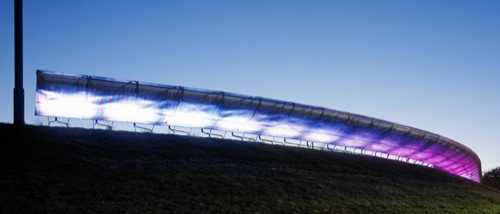
        <p>The DayCaster stands at the eastern edge of Exeter, Devon, welcoming the traveller with a curved gateway of coloured light. It was designed by architects <em>Sutherland and Hussey</em> in 2004 to celebrate the move to Exeter of the UK's premier weather forecasting institution, the <em>Met Office</em>, whose new headquarters are nearby.</p>

<img src="/images/exeter4-500.jpg" title="The Daycaster soon after construction" alt="The Daycaster soon after construction" >

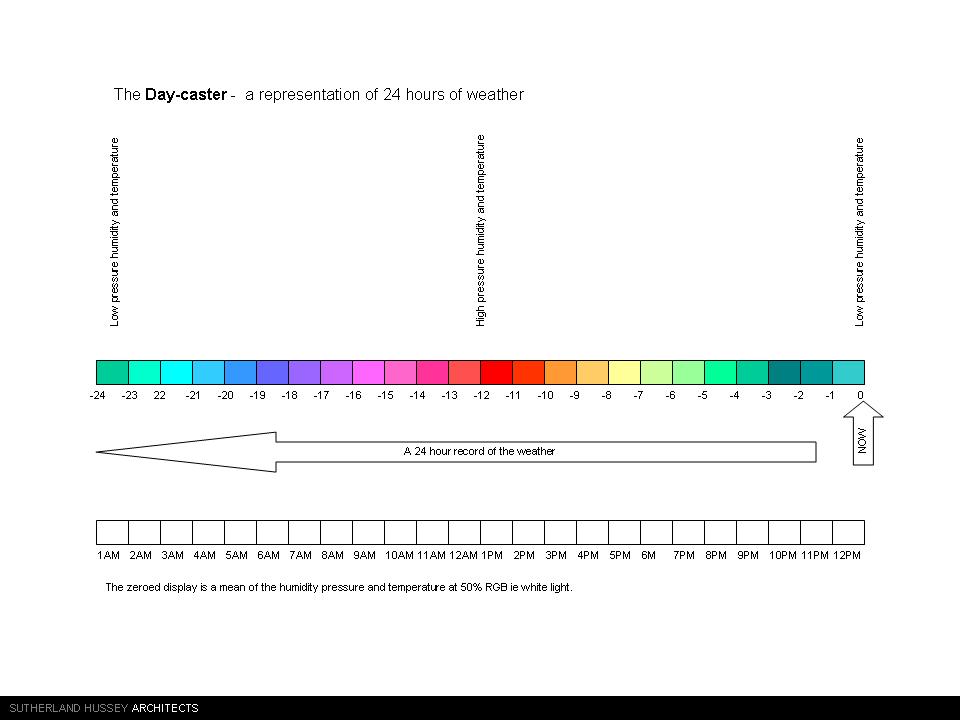
<p>The Daycaster provides an ever-changing display of coloured light that records recent changes in the weather. There are 24 banks of 3 LEDs, one for each of the previous 24 hours. Data collected by the Met Office is downloaded every hour to a small computer, which compares the readings with the average for the current season. The differences are combined to generate a single colour. When warmer and drier than average, the segment tends towards magenta; when colder and wetter, the segment tends towards blue. Average conditions are shown as a neutral (or white) light.</p>

<img src="/images/daycaster-neglected.jpg" title="The Daycaster in 2011: neglected" alt="The Daycaster in 2011: neglected" >

<p>If you watch the DayCaster for a whole day, you'll see the colours shift slowly left. The segment at the rightmost end indicates the weather conditions during the last hour; the colours slide to the left, one segment an hour, until it eventually disappears off the left end 24 hours later. When you look at the DayCaster, you're seeing the previous day at a glance.</p>
  <p><b>Of course, the above descriptions refer to the Daycaster as it was originally designed. Unfortunately, after more than ten years, time and the weather have taken their toll, and the Daycaster, long neglected by cash-strapped Exeter City Council, now rarely works at all.</b></p>
  
        
]]></content>
  </entry>

<entry>
   <title>Meteorological information</title>
   <link rel="alternate" type="text/html" href="http://daycaster.org/meteorologicalinformation" /> 
   <id>http://daycaster.org/meteorologicalinformation</id> 
   <published>2009-08-25T22:31:43Z</published>
   <updated>2009-08-25T22:31:43Z</updated>
   <author>
     <name>daycaster</name>
     <uri>http://daycaster.org/</uri>
   </author>

<content type="html" xml:base="http://daycaster.org/" xml:lang="en"><![CDATA[
<style>
pre, code
{
	font-family: Monaco, 'Andale Mono', 'Lucida Console', monospace;
  font-size: 10pt;
  /* http://users.tkk.fi/~tkarvine/pre-wrap-css3-mozilla-opera-ie.html */
	/* css-3 */
	/* Mozilla, since 1999 */
	/* Opera 4-6 */
	white-space: -o-pre-wrap;
	/* Opera 7 */
	word-wrap: break-word;
	/* Internet Explorer 5.5+ */
}

.sym  {	color:	#30f;	 }
.built-in  {	color:	#d00;	font-weight: bold }
.obsolete  {	color:	#ff0; background:	#000;}
.variable  {	color:	#807; }
.open-paren	  {	color:	#777;	}	 
.close-paren	  {	color:	#777;	}                        
.braced-string	  {	color:	#266; background:	#eff;}	                      
.quoted-string	  {	color:	#266; background:	#eff;}
.bracketed-string	  {	color:	#266; background:	#eff;}
.quote	  {	color:	#200;	}	 
.comment	  {	color:	#666;	 font-family: serif;} 
.integer	  {	color:	#333;	 }	 
.float	  {	color:	#333;	 }
.hex	  {	color:	#336;	}
.octal	  {	color:	#363;	}

</style>    
        <h2>Summary</h2><p>The Daycaster displays information about the weather during the past 24 hours.</p>
  <p>The data consists of hourly air temperature readings (in degrees Celsius) and hourly mean sea level pressure readings (in millibars), observed at one of the Met Office's observing stations, at Dunkeswell, near Honiton. The temperature readings from Dunkeswell are increased by 1.5 degrees Celsius to approximate temperatures at the more urban location of the Daycaster.</p>
  <p>The temperature and pressure readings for the past 24 hours are stored in a file on one of the Met Office servers. A new file is created each hour. The Daycaster installation collects, processes, and displays the data, using its onboard computer.</p>
  <p>The Daycaster is managed and maintained by Exeter City Council. The Met Office only collects the data and makes it available to the Daycaster.</p>

<h2>Consultants</h2>

<p>David Narro Engineers
Kevan Shaw- lighting
Neil Monroe- lighting software design
Ray Dolby- Lighting installation</p>

<h2>Contractor</h2>

<p>Parkins Engineering- metal structure
Skinners- Concrete foundation
Richard Horley- electrical installation</p>

<h2>Client</h2>

<p>Exeter City Council</p>

<h2>Value</h2>

<p>£89,000</p>

<h2>The original project description</h2>

<p>The Daycaster acts as a new gateway into the city of Exeter on the radial Honiton road. It celebrates and draws attention to the Met Office HQ’s relocation to Exeter. It occupies a site between this new HQ and the old historical records office to the south.</p>

<p>The structure is expressed in 24 segments, such that each chronologically represents hours in the preceding 24 hours. It makes play of meteorological data using a changing lighting display. This light is reflected from stainless steel baffles to its transient audience. The Met Office constantly receives climatic data and the Daycaster acts a visual manifestation of this ongoing measurement, analogous to a barometer.</p>

<p><img src="/images/diagram.jpg" title="early conceptual diagram" alt="early conceptual diagram" width="400"></p>

<p>A live feed of data from the Met Office is processed and continuously affects the hue and intensity 24 banks of LEDs underneath the length of the structure. The Hue and intensity of the 1st LED will migrate along the device, hour by hour, until 23 hours later it drops off the other end.</p>

<p>The hues vary from blue to magenta via white. Average conditions are described with white light. When conditions are more inclement the lighting tends towards the blue spectrum, in contrast when warmer than average, it tends towards the magenta spectrum. Variables of temperature and humidity both shape the Daycaster’s hues, intensity and display.</p>

<p>The information is supplied through a wi-fi web-link using the dynamic data-feed supplied by the Met Office. The radio receiver located at one end of the Daycaster receives data via wi-fi from a nearby building. The Daycaster’s circuits process this data according to its own algorithms and control the LED colours and intensity accordingly.</p>

<p>The Daycaster mediates the ground between the ephemeral world of meteorology and the tangible reality of our weather in a responsive structure, slow but dynamic, reflective of climate both day and night.</p>

  </p>
        
]]></content>
  </entry>

<entry>
   <title>Find the Daycaster on Google Maps</title>
   <link rel="alternate" type="text/html" href="http://daycaster.org/findthedaycasterongooglemaps" /> 
   <id>http://daycaster.org/findthedaycasterongooglemaps</id> 
   <published>2009-08-24T23:14:11Z</published>
   <updated>2009-08-24T23:14:11Z</updated>
   <author>
     <name>daycaster</name>
     <uri>http://daycaster.org/</uri>
   </author>

<content type="html" xml:base="http://daycaster.org/" xml:lang="en"><![CDATA[
<style>
pre, code
{
	font-family: Monaco, 'Andale Mono', 'Lucida Console', monospace;
  font-size: 10pt;
  /* http://users.tkk.fi/~tkarvine/pre-wrap-css3-mozilla-opera-ie.html */
	/* css-3 */
	/* Mozilla, since 1999 */
	/* Opera 4-6 */
	white-space: -o-pre-wrap;
	/* Opera 7 */
	word-wrap: break-word;
	/* Internet Explorer 5.5+ */
}

.sym  {	color:	#30f;	 }
.built-in  {	color:	#d00;	font-weight: bold }
.obsolete  {	color:	#ff0; background:	#000;}
.variable  {	color:	#807; }
.open-paren	  {	color:	#777;	}	 
.close-paren	  {	color:	#777;	}                        
.braced-string	  {	color:	#266; background:	#eff;}	                      
.quoted-string	  {	color:	#266; background:	#eff;}
.bracketed-string	  {	color:	#266; background:	#eff;}
.quote	  {	color:	#200;	}	 
.comment	  {	color:	#666;	 font-family: serif;} 
.integer	  {	color:	#333;	 }	 
.float	  {	color:	#333;	 }
.hex	  {	color:	#336;	}
.octal	  {	color:	#363;	}

</style>    
        
   
   <iframe width="425" height="350" frameborder="0" scrolling="no" marginheight="0" marginwidth="0" src="http://maps.google.co.uk/maps?f=q&amp;source=s_q&amp;hl=en&amp;geocode=&amp;q=50.725831,+-3.469614&amp;sll=53.800651,-4.064941&amp;sspn=12.292461,21.928711&amp;ie=UTF8&amp;ll=50.72604,-3.469624&amp;spn=0.102796,0.171318&amp;z=12&amp;output=embed"></iframe><br /><small><a href="http://maps.google.co.uk/maps?f=q&amp;source=embed&amp;hl=en&amp;geocode=&amp;q=50.725831,+-3.469614&amp;sll=53.800651,-4.064941&amp;sspn=12.292461,21.928711&amp;ie=UTF8&amp;ll=50.72604,-3.469624&amp;spn=0.102796,0.171318&amp;z=12" style="color:#0000FF;text-align:left">View Larger Map</a></small>
   
        
]]></content>
  </entry>

<entry>
   <title>Article from Building Design, Jan 7 2005</title>
   <link rel="alternate" type="text/html" href="http://daycaster.org/articlefrombuildingdesignjan72005" /> 
   <id>http://daycaster.org/articlefrombuildingdesignjan72005</id> 
   <published>2009-08-24T23:13:28Z</published>
   <updated>2009-08-24T23:13:28Z</updated>
   <author>
     <name>daycaster</name>
     <uri>http://daycaster.org/</uri>
   </author>

<content type="html" xml:base="http://daycaster.org/" xml:lang="en"><![CDATA[
<style>
pre, code
{
	font-family: Monaco, 'Andale Mono', 'Lucida Console', monospace;
  font-size: 10pt;
  /* http://users.tkk.fi/~tkarvine/pre-wrap-css3-mozilla-opera-ie.html */
	/* css-3 */
	/* Mozilla, since 1999 */
	/* Opera 4-6 */
	white-space: -o-pre-wrap;
	/* Opera 7 */
	word-wrap: break-word;
	/* Internet Explorer 5.5+ */
}

.sym  {	color:	#30f;	 }
.built-in  {	color:	#d00;	font-weight: bold }
.obsolete  {	color:	#ff0; background:	#000;}
.variable  {	color:	#807; }
.open-paren	  {	color:	#777;	}	 
.close-paren	  {	color:	#777;	}                        
.braced-string	  {	color:	#266; background:	#eff;}	                      
.quoted-string	  {	color:	#266; background:	#eff;}
.bracketed-string	  {	color:	#266; background:	#eff;}
.quote	  {	color:	#200;	}	 
.comment	  {	color:	#666;	 font-family: serif;} 
.integer	  {	color:	#333;	 }	 
.float	  {	color:	#333;	 }
.hex	  {	color:	#336;	}
.octal	  {	color:	#363;	}

</style>    
        <p><b>Looks like rain</b>: Damian Arnold reports on a weather-recording art installation in Exeter by Sutherland Hussey</p>

<p>Drivers passing through a previously bleak and unprepossessing roundabout near Exeter could now be forgiven for thinking the northern lights had migrated to Devon. The West Country version of the Aurora Borealis is in fact an illuminated 40m-long steel structure known as the Daycaster, which uses colour to silently report the weather of the past 24 hours.</p>

<p>If a strip of bright magenta is projected into the night sky you're reminded of the current heat wave. If it's a blue haze on the horizon as you drive into Exeter then you're in the middle of a cold snap. And drivers who pass the Daycaster regularly are already beginning to recognise the subtleties of colour in between to enjoy a weather report with a far richer mix of colours than ever seen on the 1970s kipper ties of Michael Fish.</p>

<p>The newly completed &pound;190,000 installation on the crest of a bank overlooking the Honiton roundabout is the brainchild of Sutherland Hussey architects, shortlisted for the 2003 Stirling Prize for its Tiree ferry shelter.</p>

<blockquote>
<p>The Daycaster sits astride the Meteorological Office station and its records office where the data is then archived.  We wanted to represent the idea of this data passing between two buildings,  </p>
</blockquote>

<p>Charlie Sutherland says.</p>

<blockquote>
<p>We felt that needed to be registered somehow in the public realm.</p>
</blockquote>

<p>Twenty four sets of 24 LEDs emitting a mixture of magenta, green and blue rays are set underneath the Daycaster. The practice was dissuaded from using its preferred traffic light colours of red, green and orange on the grounds that it might confuse drivers. The colours can be mixed to produce a range of hues which also vary in intensity to show changes in pressure. The steel structure is divided into 24 sections, each one representing one hour of the previous 24, and coloured to show what the weather was like in that hour.</p>

<p>A website at the Met Office sorts the weather data and sends it by a wireless connection to the Daycaster's onboard computer which transforms the information into colours.</p>

<p>The lights are positioned in a trough underneath the structure set into the concrete foundations and protected by a metal grille, to avoid vandalism. The lights project upwards to illuminate a steel structure that the architect likens to an aerofoil. Sutherland Hussey worked with structural engineer David Narro to create a design that cantilevers at an extreme angle over the bank. This is made possible by its bent steel reinforcement bars that criss-cross along the structure to give it stiffness and form the aeroplane wing shape. The wing is clad with a galvanised steel mesh to add rigidity - just as well given a vandal-busting safety audit that involved three heavy men bouncing on top of the Daycaster.</p>

<blockquote>
<p>We needed the structure to be at a certain angle for best projecting light,  </p>
</blockquote>

<p>explains Sutherland.</p>

<blockquote>
<p>We needed it to overhang the bank so that visually it had some power and strength. </p>
</blockquote>

<p>The reinforcement bars extend behind the Daycaster to counterbalance the structure. The bars also suspend the main structural element half a metre above the ground to create the effect of a floating cloud of light.</p>

<blockquote>
<p>It's designed to float at the top of the bank so it doesn't look as though it's anchored and you can see the light below it</p>
</blockquote>

<p>says Hussey.</p></p>

<p>Now the practice is working on adapting the colours.

<blockquote>
<p>We have got some tuning to do with the colours because it is quite a sensitive instrument,  </p>
</blockquote>

<p>says Sutherland.</p>

<blockquote>
<p>We are testing the colour to see if it needs to be more extreme and more readable.</p>
</blockquote>

<p>Weeks after it started to light up the night sky the Daycaster has gone down well with the locals who, Sutherland says, are becoming increasingly fond of the landmark. Despite an article in the local press criticising the use of public money for an art installation, the architects have been inundated with letters of support from local people.</p>

<blockquote>
<p>We wanted the Daycaster to build up a reputation by word of mouth so it could build up its own little myth, says Sutherland.  We didn't really intend for people to just say we understand it right away.</p>
</blockquote>

        
]]></content>
  </entry>

<entry>
   <title>Exeter City Council press release: 23 November 2004</title>
   <link rel="alternate" type="text/html" href="http://daycaster.org/exetercitycouncilpressrelease23november2004" /> 
   <id>http://daycaster.org/exetercitycouncilpressrelease23november2004</id> 
   <published>2009-08-24T23:12:17Z</published>
   <updated>2009-08-24T23:12:17Z</updated>
   <author>
     <name>daycaster</name>
     <uri>http://daycaster.org/</uri>
   </author>

<content type="html" xml:base="http://daycaster.org/" xml:lang="en"><![CDATA[
<style>
pre, code
{
	font-family: Monaco, 'Andale Mono', 'Lucida Console', monospace;
  font-size: 10pt;
  /* http://users.tkk.fi/~tkarvine/pre-wrap-css3-mozilla-opera-ie.html */
	/* css-3 */
	/* Mozilla, since 1999 */
	/* Opera 4-6 */
	white-space: -o-pre-wrap;
	/* Opera 7 */
	word-wrap: break-word;
	/* Internet Explorer 5.5+ */
}

.sym  {	color:	#30f;	 }
.built-in  {	color:	#d00;	font-weight: bold }
.obsolete  {	color:	#ff0; background:	#000;}
.variable  {	color:	#807; }
.open-paren	  {	color:	#777;	}	 
.close-paren	  {	color:	#777;	}                        
.braced-string	  {	color:	#266; background:	#eff;}	                      
.quoted-string	  {	color:	#266; background:	#eff;}
.bracketed-string	  {	color:	#266; background:	#eff;}
.quote	  {	color:	#200;	}	 
.comment	  {	color:	#666;	 font-family: serif;} 
.integer	  {	color:	#333;	 }	 
.float	  {	color:	#333;	 }
.hex	  {	color:	#336;	}
.octal	  {	color:	#363;	}

</style>    
        <p>Exeter's Daycaster goes live tonight (Tuesday 23 November) with a blast of colour and light.
The exciting feature, situated on land beside the Honiton Road interchange, will be powered up fully for the first time at 6.15pm.</p>

<p>Designed by Edinburgh based Sutherland Hussey Architects, it will act as a gateway to the eastern approach to Exeter and celebrates the relocation of the Met Office to the city.</p>

<p>The Daycaster is located midway between the Met Office, where new weather data is continually being processed, and Great Moor House, which contains the new Met Office archive and County Record office, where data is stored for posterity.</p>

<p>The Daycaster articulates through the use of light, changing environmental conditions, contrasting live data against historical data.</p>

<p>A solid-state computer, through a linkage to a website, gathers live temperature and pressure readings; these readings are then contrasted against the average weather conditions for the time of year. The resulting difference between the actual weather conditions and past average conditions is recorded in differing intensities of coloured light.</p>

<p>Twenty-four lighting units represent the previous 24 hours, with the lighting units nearest the bus stop representing the most recent hour and the end nearest the interchange representing the weather conditions at the same time the previous day.</p>

<p>The colour of the Daycaster varies from blue to magenta depending on the data sent to the lighting units. White light is produced when the weather conditions are similar to the average conditions. When it is colder, the colour moves towards the blue spectrum, when warmer, towards the magenta spectrum. As a result of changing weather conditions the Daycaster will show a slow but dynamic change.</p>

<p>The project has only been achieved through the close collaboration between Exeter City Council, the Met Office and Devon County Council. It has been funded principally by the South West Regional Development Agency (RDA), with support also from Exeter City Council.</p>

<p>Steve O'Higgins, from the South West Regional Development Agency, said:</p>

<blockquote>
<p>We worked closely with a wide range of partners in Exeter to deliver the Met Office re-location. The Daycaster is a fitting tribute to a successful move that has helped to raise the region's profile as a centre for innovation and an exciting place to do business.</p>
</blockquote>

<p>Cllr Mike Mills, Exeter City Council's Lead Councillor for Planning and Transportation said:</p>

<blockquote>
<p>"The City Council is committed to delivering distinctive public art in the city centre and on gateways into Exeter. I am very pleased to see that the Daycaster is now up and running which completes our work on the Met Office re-location."</p>
</blockquote>


<p>Councillor David Morrish, Devon County Council's Executive Member for Environment said:</p>

<blockquote>
<p>"The County Council has invested heavily in the transport infrastructure of Sowton in the last two years. It is important that we also create a high quality landmark at this key entrance to Exeter."</p>
</blockquote>

<p>Steve Noyes, Chief Technical Officer at the Met Office, said:

<blockquote>
<p>"The weather is always a topic of conversation. Visitors to the Met Office and Exeter now have the Daycaster as a dramatic attraction at the entrance to the city. It represents the temperature - a fundamental aspect of the weather, in a very colourful and exciting way."</p>
</blockquote>

        
]]></content>
  </entry>


</feed>